

Here's What Just 3 Weeks Of Acupuncture Did For My Digestion, Sleep & Energy Levels

Acupuncture always seemed like a voodoo-type practice to me, so I never considered it an option. However, I recently experienced about two months of consistent bloating to the point that I looked three months pregnant in a swimsuit. I tweaked my diet, cut out coffee, started meditating more, but still the bloating remained. So, I decided to finally give acupuncture a try. What could happen? After all, I have been battling ulcerative colitis for nine years now and have become open to just about anything that will alleviate my symptoms.

I saw an acupuncturist twice a week for one month. He applied traditional acupuncture techniques while incorporating craniosacral work. Here's what happened:

Week 1:

After my first week of treatment, my bloating decreased significantly to where I no longer felt discomfort. Unexpectedly, I also noticed fewer chronic fatigue symptoms. I often get body aches but those were gone and I felt like I had quite a bit more energy.

Week 2:

I told the acupuncturist that I was having a hard time sleeping so he adjusted his needle points accordingly and began performing craniosacral work on my head and neck. Without realizing it, I fell asleep on the table almost immediately and had the most restful sleep I'd had in a while. Even more, I've been able to sleep well and wake up feeling rested ever since this treatment.

In addition, I usually know when my period is about to start by the severe back pain and discomfort in the day and hours leading up to it. The first day of my period is always the worst—and I mean the absolute worst. Painful cramps normally plague me on the first and second day. This time around? I had NONE—I couldn't believe it. The second day showed very slight discomfort but was the easiest period I’ve had in a long time. To me, this meant that the acupuncture was lowering my inflammation levels and helping ease my hormonal changes throughout the month.

Week 3:

I didn’t fall asleep this time, but that is likely because I was already getting great sleep at night and was feeling very alert. I mentioned to the acupuncturist that I was having exams in grad school and that I was stressed about them. Again, he adjusted the location of the needles and let me rest on the table, listening to Bob Marley. Maybe it was the needles, maybe it was Bob—or probably a combination of the two—but I felt like I had just had a massage as I walked out of the office. I also started feeling more alert and energized during the day, without the help of coffee, and was able to focus in classes better than before.

The take-home message? Acupuncture is the bee’s knees! I am officially a skeptic turned believer in just three short weeks. Will the effects keep on lasting? It's hard to say, but so far so good. My health condition is not an easy one to manage, so knowing that this is a viable option for me to help keep my symptoms at bay is absolutely priceless.

This article originally appeared on MindBodyGreen & was written by Holly Campbell.

4 Exercises to Prevent Back Pain From Cycling

Lower back pain is one of the most common injuries among cyclists. What you might not realize is that most of these injuries are due to muscular imbalances that can easily be prevented.

While serious conditions such as a herniated disc or a strained muscle warrant a break from the bike, most low-level chronic back pain that results from muscular imbalances can be fixed before resulting in injury.

A muscular imbalance occurs when the workload is not being distributed evenly or efficiently, and can cause certain muscles to work either too hard or not enough.

More: Exercises to Treat Shoulder and Neck Pain From Cycling

The transversus abdominus, or TVA—the deep abdominal muscles that wrap around the entire core—and the gluteus maximus are two common muscles that can lead to back pain if they aren't working efficiently. The correlation between weakness in these muscles and low back pain is directly related to the order in which these muscles activate.

If they aren't firing correctly, and in the right order, these muscles won't provide the stabilization needed to support the lumbar spine.

In a healthy person, the TVA should activate a fraction of a second before any movement takes place in the limbs. If the TVA doesn't fire, the pelvis and lumbar spine aren't properly stabilized during movement and the low back is allowed to move around too much, stressing the muscles of that area and eventually causing chronic pain.

More: How to Avoid Lower Back Pain While Cycling

The solution is to follow a core exercise routine that helps strengthen the TVA and gluteus maximus. Stay away from abdominal crunches; the crunch movement only exacerbates the rounded shoulders and tucked pelvis that contributes to low back pain.

Below are four core-strengthening exercises that will help to alleviate chronic low back pain. Start with one set of each exercise and rest 30 seconds between. Increase your repetitions gradually until you can complete 2 to 3 sets of each exercise.

Opposite Arm/Leg Reach

Start on your hands and knees. Keep the back of your neck long and don't look up or let your chin drop toward the ground. Gently pull your belly button up, being careful not to round your upper back. Keep your hips and shoulders parallel to the ground and lift your right foot and left hand at the same time...

More: 7 Simple Stretches for Cyclists


...Extend your left fingertips forward and squeeze your left gluteus. Hold this extension for 5 seconds before slowly returning to the starting position. Continue alternating sides until you have completed 10 repetitions on each side.

Prone Snow Angels

Lie face down on a mat with your arms extended along your sides (palms down). Gently squeeze your glutes and begin to raise your feet, chest and hands off the ground. Don't lift your feet more than 6 inches. Create a "snow angel" by sweeping your arms overhead and separating your feet. Without bending your arms, try to bring your hands together above your head. Return to starting position, take a deep breath, and repeat until you have completed 10 to 15 repetitions.

Shoulder Blade Squeeze

Start on your hands and knees. Place your hands directly below your shoulders as if you were going to do a push-up. Keep your arms straight and drop your shoulder blades down, squeezing the lower edges together. Don't let your low back sway or your chin push forward. Hold the shoulder blade squeeze for 5 seconds and release. Take a breath, then continue to repeat this 5-second hold until you have completed 10 repetitions.

More: 8 Single-Leg Exercises to Increase Power

Time Trial Position (Plank Hold)

The TT Hold is performed on your forearms and toes. The exercise is isometric and there should be no movement. Keep your elbows directly beneath your shoulders, and your feet should be 8 to 10 inches apart. Keep the back of your neck long and look down at the floor.

Work to bring your shoulder blades onto your back by squeezing them together slightly. Your lower back should not be excessively rounded, and your neck should be long (don't look up). Hold this position for 20 to 30 seconds. As you become stronger, extend the hold time.


This article originally appeared on Active.com and was written by Allison Westfahl

Floating While Pregnant

Upon gaining a doctor’s approval, there has been a growing trend of floating during pregnancy. Some take on floating to help reduce back pain while others just love to hear their baby’s heartbeat underwater.

The rise in floating while pregnant has sparked a lot of questions. While any medical questions are obviously best left to the doctors, there are some obvious queries that are clearly float related. Like, ‘how to comfortably float while with child,’ for instance.

..The following are a few suggestions. First of all, (rest assured) it is safe for pregnant women to float on their back or their belly. Outside of the tank, this position would be risky for the health of the mom and the baby, however, in the weightlessness of a sensory deprivation tank this doesn’t appear to be the case.*

Be sure to ask and know how to get in and out of the tank cautiously, as the surfaces will be slippery and [your] sense of balance might be a bit wonky.

Getting Into a Comfortable Floating Position

Successfully accomplishing the following positions may depend on factors such as height, body type, and ultimately personal preference:

floating-pregnant_arms-under-noodle-1024x553.png


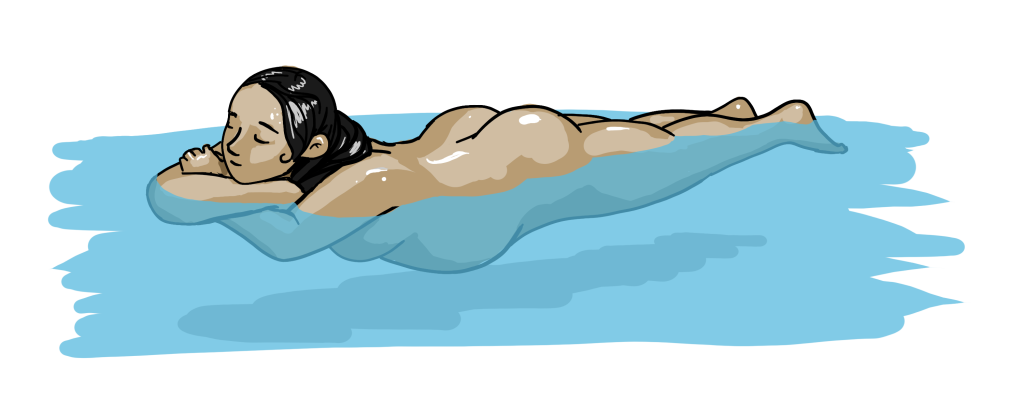
You may want to have neck pillows for your float. One good option for a neck pillow is a pool noodle cut in half crosswise, so it can fit sideways in your sensory deprivation tank. A pregnant woman can actually lay on her belly while she floats, with her arms across the noodle, and the noodle under her chin to keep her face out of the water. Even if she falls asleep, her head will remain supported by the noodle. 


Another suggestion for floating belly down in the water is to have your elbows on the floor of the tank and chin in hands. The depth of the water is approximately the length of your forearms, so your face will remain dry. Some women find this satisfying as the position provides a great stretch to the spine.


A pregnant floater might also be comfortable crossing her arms under her chin and floating belly down in the water, resting her head on her forearms. This is very similar to floating with a pool noodle, and for some, might be preferable. Floating belly down can be a real release of pressure during pregnancy: a lot of the weight of the growing uterus pushes against the mother’s organs, and letting the salt water support this weight for 60 minutes can be quite blissful.


As far as tips for a pregnant woman floating on their back, know you are safe to float this way (again, pending approval from your doctor). You could use the noodle pillow under your lower back, but probably won’t need it. Chances are that the Epsom salt will support her and baby beautifully.


It is a great time for mother and baby to bond, and for Mom to get a bit of rest and relaxation.


Dads Need Floats Too


Dad floats as well, after all fathers have needs too! It can be quite stressful and exhilarating preparing for a new baby, and floating is always an amazing stress reliever, regardless of whether or not you actually have another life form actually growing inside of you.


Only With Doctor’s Approval


We are not a medical centre, nor have doctors or medical professionals within our clinic. We can offer tips from the personal experiences of previous pregnant floaters. The conditions of every pregnancy can be different and all expecting mothers should seek the approval of their doctor before floating.

Some sources online state that women should not float during their first trimester. There is no data we’ve found to support this concern, but this seems reasonable that it’s in place because many miscarriages happen during the first trimester. If a woman miscarried right after her float, or she attributed a miscarriage to floating, this could be terrible for everyone involved.

Miscarriages happen frequently, somewhere between 5%-75% of pregnancies miscarry within the first trimester depending on the conditions** (the higher percentage in this scale are IVF pregnancies that fail to implant properly and those families can be the most devastated by miscarriages).

Definitely take all of the information presented in this blog post with a grain of salt, and make sure that you consult your medical doctor before booking a float therapy appointment. Floating through pregnancy can be a real load off – in many ways.

For more reading, check out my personal blog about floating while pregnant.

This article originally appeared on floattanksolutions.com and was written by Leah Pellegrini

* The risk is related to a pregnant woman lying down on her back (on a flat surface, not a float tank) is due to constriction of blood flow to the placenta. This can interfere with the development of the baby. Also, the weight of the uterus can put pressure on major veins causing dizziness and discomfort for the mother. In a sensory deprivation tank, this doesn’t seem to happen, because there is no rigid surface behind the mother to cause detrimental pressure on the circulatory system. Furthermore, floating has been shown to have positive benefits such as lowering blood pressure, which can also help a pregnant mother to have healthy blood flow to her heart and to the baby’s placenta.

** statistical numbers gathered from Friedman, Lynn, M.D. and Irene Daria. Miscarriage: A Woman Doctor’s Guide. New York: Kensington Health: 2001

SERVICES TO COMPLIMENT FLOAT THERAPY FOR PREGNANT WOMAN: Massage Therapy and Acupuncture

BOOK ONLINE

Muscle Adhesions: Getting in the Way of Your Performance

WHAT ARE ADHESIONS?

Our bodies contain special protein structures called connective tissue, also know as Fascia. This substance connects each part to other parts and the whole, very much like a flexible skeleton. When this tissue is healthy it is smooth and slippery, allowing the muscles, nerves, blood vessels or organs to move freely and function properly. Imagine a piece of scotch tape, the smooth side is healthy fascia; the sticky side is scar tissue or unhealthy fascia. Rub the tape along your skin, both sides, to "feel" what an adhesion is like. The drag that you feel, the "pulling" sensation, is what an adhesion is like. These adhesions attach to muscles, nerves and lymph decreasing their ability to work properly. You really know when you have an adhesion on a nerve; you get many abnormal sensations like numbness, tingling or pain.

DOESN'T STRETCHING GET RID OF ADHESIONS?

Stretching plays a very important role in the treatment and prevention of injuries but it will not break down adhesions. Adhesions, or scar tissue, are much stronger than normal healthy tissue. Muscle groups can often adhere/bind to one another preventing the normal sliding necessary for full mobility. When an individual performs a stretch, the tissue that lengthens is not the adhered tissue but the healthy tissue. This can actually cause more damage to healthy tissue resulting in the increase of adhesions. Stretching correctly is still essential, but it will never release the restrictions that are already present.

HOW WILL EXERCISES AND STRETCHING THAT DID NOT WORK BEFORE, WORK AFTER (ART) TREATMENTS?

Stretching and exercises are only effective after the dysfunction within the soft-tissue structures have been correctly released. Stretching and exercising dysfunctional tissues will only lead to a dysfunctional result. The combination of finding the origin of the problem, (ART) treatments, functional training, stretching and behavioral modifications will result in long lasting results...

HOW DO OVERUSE CONDITIONS OCCUR?

Over-used muscles (and other soft tissues) change in three important ways:

  • Acute conditions (pulls, tears, collisions, etc),
  • Accumulation of small tears (micro-trauma)
  • Not getting enough oxygen (hypoxia).

Each of these factors can cause your body to produce tough, dense scar tissue in the affected area. This scar tissue binds up and ties down tissues that need to move freely. As scar tissue builds up, muscles become shorter and weaker, tension on tendons causes tendonitis, and nerves can become trapped. This can cause reduced range of motion, loss of strength, and pain. If a nerve is trapped, you may also feel tingling, numbness, and weakness.

This article originally appeared on performance-therapy.com

BOOK ONLINE FOR YOUR MASSAGE THERAPY, DRY NEEDLING AND CUPPING MASSAGE NEEDS TO ADDRESS SCAR TISSUE AND MUSCLE ADHESION ISSUES.

BOOK ONLINE