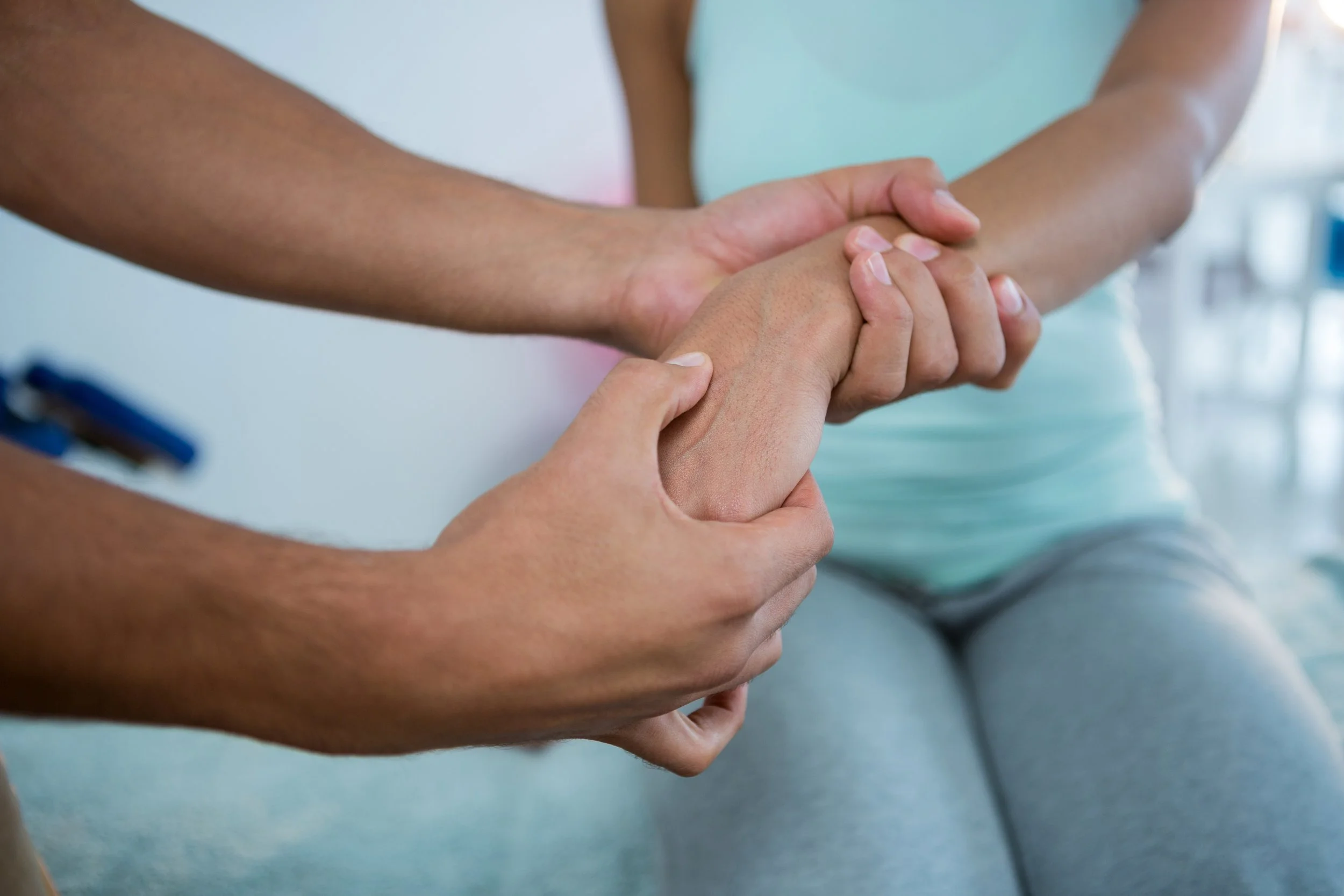


Foot and Ankle Pain: Osteopathy Sets Pace for Restored Function

Pain can occur in the foot and ankles for a number of reasons.

The foot and ankle is made up of a number of small bones interconnected by ligaments, muscles and fascia all working together to give the strength, stability and flexibility the foot and ankle needs to function properly.
Common conditions of the foot, ankle and areas which can give rise to pain include:

Acquired flat foot – when the inner side of the foot or inner arch flattens. The foot may roll over to the inner side (known as over-pronation). It is often apparent if the heels of shoes wear out quickly and unevenly. Over-pronation can damage your ankle joint and achilles tendon (the tendon at the back of your ankle) and can also cause shin pain. Symptoms can include, pain, swelling, change in foot shape and knee pain or swelling.

Plantar fasciitis –is pain and inflammation in the plantar fascia – the tough fibrous band of tissue that supports the arches of the foot and runs under the small bones from the underside of the heel and sole towards the toes, Often, people who have plantar fasciitis describe it as a sharp pain, most often under the heel or instep of the foot. It tends to be made worse by standing for long periods of time in poor footwear. Sufferers commonly mention that it is worse when standing after being off their feet for a long time, and it can hurt more putting the foot on the floor first thing in the morning. The sole of the foot can occasionally feel a little numb, tingly or swell slightly. In some cases of plantar fasciitis, a small spur of bone can grow where the plantar fascia attaches and pulls on the heel which can cause a sharp pain.

Achilles pain –The Achilles tendon is formed by the tendon of the two calf muscles, the gastrocnemius and soleus coming together and attaching onto the bone at the back of the heel called the calcaneus) Pain, inflammation or tendonitis in the Achilles can cause pain and tightness in this area.

Sprained ankle. Typically the result of a sudden twisting or “going over” on the ankle joint and more commonly it is the ligaments on the outside of the ankle that are strained. Typical symptoms are swelling, bruising, pain and instability of the ankle. Sometimes an x-ray is required to rule out any fracture. Rest, ice, elevation and compression are often advisable in the first 24 to 48 hours.

How can an osteopath help with foot and ankle pain?

  • Depending on the diagnosis and your age and fitness we can use a variety of gentle massage and manipulative techniques to increase the mobility of the joints and the flexibility of the muscles in the foot.
  • We will often look at muscles and joints in the lower limb, the knee, hip and lower back and may treat any joint restrictions and muscle tightness we find there. Often improving the movement in the joints of the lower will help the foot and ankle function better.
  • We may offer specific balancing, strengthening or loosening exercises
  • We may offer advice on strapping and brace supports, footwear and any lifestyle factors that might be hindering healing. We may refer you to a podiatrist for their opinion and specialist foot supports
  • X-rays, scans or other tests may be required to make a diagnosis  and we may refer you to your  GP for any additional  investigations and treatment  such as advice on pain killers and anti-inflammatory medications.

    This article originally appeared on http://www.osteopathy.org

When you feel discomfort in your feet and ankles you are feeling the imbalance of your body's weight distributed unevenly. Help your body reset and restore itself by moving your feet outside their normal range, keeping your hips flexible, and always moving your arms behind your torso for short and frequent periods of time. #Moveintobetterhealth

Manual Osteopathy moves your joints toward their naturally balanced and proportioned state of force distribution and absorption, helping your body fit together again! 

Early-Life Exercise Alters Gut Microbes, Promotes Healthy Brain

The human gut harbors a teeming menagerie of over 100 trillion microorganisms, and researchers at the University of Colorado Boulder have discovered that exercising early in life can alter that microbial community for the better, promoting healthier brain and metabolic activity over the course of a lifetime.

The research, which was recently published in the journal Immunology and Cell Biology, indicates that there may be a window of opportunity during early human development to optimize the chances of better lifelong health.

"Exercise affects many aspects of health, both metabolic and mental, and people are only now starting to look at the plasticity of these gut microbes," said Monika Fleshner, a professor in CU-Boulder's Department of Integrative Physiology and the senior author of the new study. "That is one of the novel aspects of this research."

Microbes take up residence within human intestines shortly after birth and are vital to the development of the immune system and various neural functions. These microbes can add as many 5 million genes to a person's overall genetic profile and thus have tremendous power to influence aspects of human physiology.

While this diverse microbial community remains somewhat malleable throughout adult life and can be influenced by environmental factors such as diet and sleep patterns, the researchers found that gut microorganisms are especially 'plastic' at a young age.

The study found that juvenile rats who voluntarily exercised every day developed a more beneficial microbial structure, including the expansion of probiotic bacterial species in their gut compared to both their sedentary counterparts and adult rats, even when the adult rats exercised as well.

The researchers have not, as of yet, pinpointed an exact age range when the gut microbe community is likeliest to change, but the preliminary findings indicate that earlier is better.

A robust, healthy community of gut microbes also appears to promote healthy brain function and provide anti-depressant effects, Fleshner said. Previous research has shown that the human brain responds to microbial signals from the gut, though the exact communication methods are still under investigation.

"Future research on this microbial ecosystem will hone in on how these microbes influence brain function in a long-lasting way," said Agniezka Mika, a graduate researcher in CU-Boulder's Department of Integrative Physiology and the lead author of the new study.

Going forward, the researchers also plan to explore novel means of encouraging positive gut microbe plasticity in adults, who tend to have stable microbial communities that are more resistant to change.

The National Institutes of Health (NIH) supported this research.

The above post is reprinted from materials provided by University of Colorado at Boulder. Note: Materials may be edited for content and length.

Your Facial Expression Is the Next Frontier in Big Data

The human face is powered, depending on how you count them, by between 23 and 43 muscles, many of which attach to the skin, serving no obvious function for survival. An alien examining a human specimen in isolation wouldn’t know what to make of them. Tugging on the forehead, eyebrows, lips and cheeks, the muscles broadcast a wealth of information about our emotional state, level of interest and alertness. It is a remarkably efficient means of communication—almost instantaneous, usually accurate, transcending most language and cultural barriers. But sometimes the data is lost, ignored or misinterpreted. If a logger smiles in the forest with no one around to see him, was he actually happy?

Rana el Kaliouby hates to see that information go to waste. Meeting el Kaliouby in her small office in Waltham, Massachusetts, I see her contract her zygomaticus major muscle, raising the corners of her mouth, and her orbicularis oculi, crinkling the outer corners of her eyes. She is smiling, and I deduce that she is welcoming me, before she even gets out the word “hello.” But many social exchanges today take place without real-time face-to-face interaction. That’s where el Kaliouby, and her company, come in.

El Kaliouby, who is 37, smiles often. She has a round, pleasant, expressive face and a solicitous manner, belying her position as the co-founder of a fast-growing tech start-up—an anti-Bezos, an un-Zuckerberg. Her company, Affectiva, which she founded in 2009 with a then-colleague at the MIT Media Lab, Rosalind Picard, occupies a position on the cutting edge of technology to use computers to detect and interpret human facial expressions. This field, known as “affective computing,” seeks to close the communication gap between human beings and machines by adding a new mode of interaction, including the nonverbal language of smiles, smirks and raised eyebrows. “The premise of what we do is that emotions are important,” says el Kaliouby. “Emotions don’t disrupt our rational thinking but guide and inform it. But they are missing from our digital experience. Your smartphone knows who you are and where you are, but it doesn’t know how you feel. We aim to fix that.”

Why does your smartphone need to know how you feel? El Kaliouby has a host of answers, all predicated on the seemingly boundless integration of computers into the routines of our daily lives. She envisions “technology to control lighting, temperature and music in our homes in response to our moods,” or apps that can adapt the content of a movie based on your subconscious reactions to it while you watch. She imagines programs that can monitor your expression as you drive and warn of inattention, drowsiness or anger. She smiles at the mention of her favorite idea—“a refrigerator that can sense when you are stressed out and locks up the ice cream.”


Read more: http://www.smithsonianmag.com/innovation/rana-el-kaliouby-ingenuity-awards-technology-180957204/#xYHMfwAxPsjZ5zO8.99
Give the gift of Smithsonian magazine for only $12! http://bit.ly/1cGUiGv
Follow us: @SmithsonianMag on Twitter

Canadian Health research: Saving Lives, Making History

Canada's health researchers have made many life-saving discoveries. From Banting and Best's insulin innovation to today's advancements in health care delivery, our country has led the way in making the world a healthier place. Learn more about Canada’s major health research achievements, and take a closer look at some of the research CIHR supported in its first 10 years.


1920s

"With the relief of the symptoms of his disease, and with the increased strength and vigor resulting from the increased diet, the pessimistic, melancholy diabetic becomes optimistic and cheerful. Insulin is not a cure for diabetes; it is a treatment."
Dr. Frederick G. Banting, Nobel Prize Lecture, 1923

1921

Insulin changes lives of diabetics
Drs. Banting and Best, Collip and Macleod discover insulin, revolutionizing the treatment of diabetes, and give the Canadian scientific community its first Nobel Prize.

1925

Of hormones and bones
Dr. James Collip discovers parathyroid hormone. The discovery increases understanding of how our bodies regulate calcium concentrations and eventually leads to new treatments for osteoporosis.

1930s

"Brain surgery is a terrible profession. If I did not feel it will become different in my lifetime, I should hate it."
Dr. Wilder Penfield

1930

Feeding babies better
Researchers at the University of Toronto announce the creation of Pablum; royalties from its sales still support research at Toronto's Hospital for Sick Children.

1934

Treating seizures in Montreal
Dr. Wilder Penfield establishes the Montreal Neurological Institute. Dr. Penfield developed a surgical method for treating epilepsy, called the Montreal Procedure.

1936

The roots of CIHR
National Research Council (NRC) establishes the Associate Committee on Medical Research.

1940s

"At the age of 20, I had my first course in histology; I enjoyed it and wondered about becoming a histologist. Friends tried to dissuade me: 'Histology,' they said, 'is a dead horse. The future is in biochemistry.' I chose histology anyway, worked at it for 50 years, and never looked back. Many exciting things happened in the field during these 50 years... all powerful kicks for a dead horse."
Dr. Charles Leblond

1944

Jumpstarting molecular research
Dr. Maud Menten, one of Canada's first female physicians, performs the first protein separation using electrophoresis. To this day, electrophoresis is a standard research tool in genetics and other biological sciences.

1945

The polio vaccine: the Canadian contribution
Dr. Raymond Parker of the University of Toronto's Connaught Laboratories discovers a chemical nutrient in which cells can grow and replicate, playing a role in the discovery of the polio vaccine.

1946

Associate Committee is replaced by NRC Division of Medical Research.

Watching the body at work
Dr. Charles Leblond develops autoradiography. This technique is later used to identify stem cells in adult organs and observe the creation of proteins in living cells.


1950s "I have worked on many other projects. Some of them classified and important. But this one (the electric wheelchair) has given me the most satisfaction… It has given me a feeling of helping others, who have not always been able to help themselves."
George Klein

1951

Canada sets the pace for cardiac care
Dr. John Alexander "Jack" Hopps develops the world's first external 'cardiac pacemaker', which electrically stimulates heart muscles.

Blasting away cancer cells
The Cobalt-60 "Bomb", developed by Howard Johns at the University of Saskatchewan, represents a tremendous step forward in cancer radiation treatment. It is estimated to have saved millions of lives, and is still in use in some parts of the world today.

Recognizing strokes
Dr. C. M. Fisher discovers that strokes are often preceded by Transient Ischemic Attacks (TIAs) - brief episodes of impaired consciousness caused by blood clots in the arteries of the brain.

1952

Helping Those Who Can't Help Themselves
George Klein invents the world's first electric wheelchair for quadriplegic patients.

1956

Healing Hodgkin's disease
Dr. Vera Peters pioneers the use of radiation in the treatment of Hodgkin's disease. Once thought to be incurable, Hodgkin's now has a survival rate of more than 90%.

1959

Scientific serendipity
Drs. Robert Noble and Charles Thomas Beer discover that the plant extract vinblastine provides an effective treatment for cancer. The chemical remains an important component of chemotherapies used to treat Hodgkin's lymphoma and lung, breast and testicular cancer.

Click the title to read more.