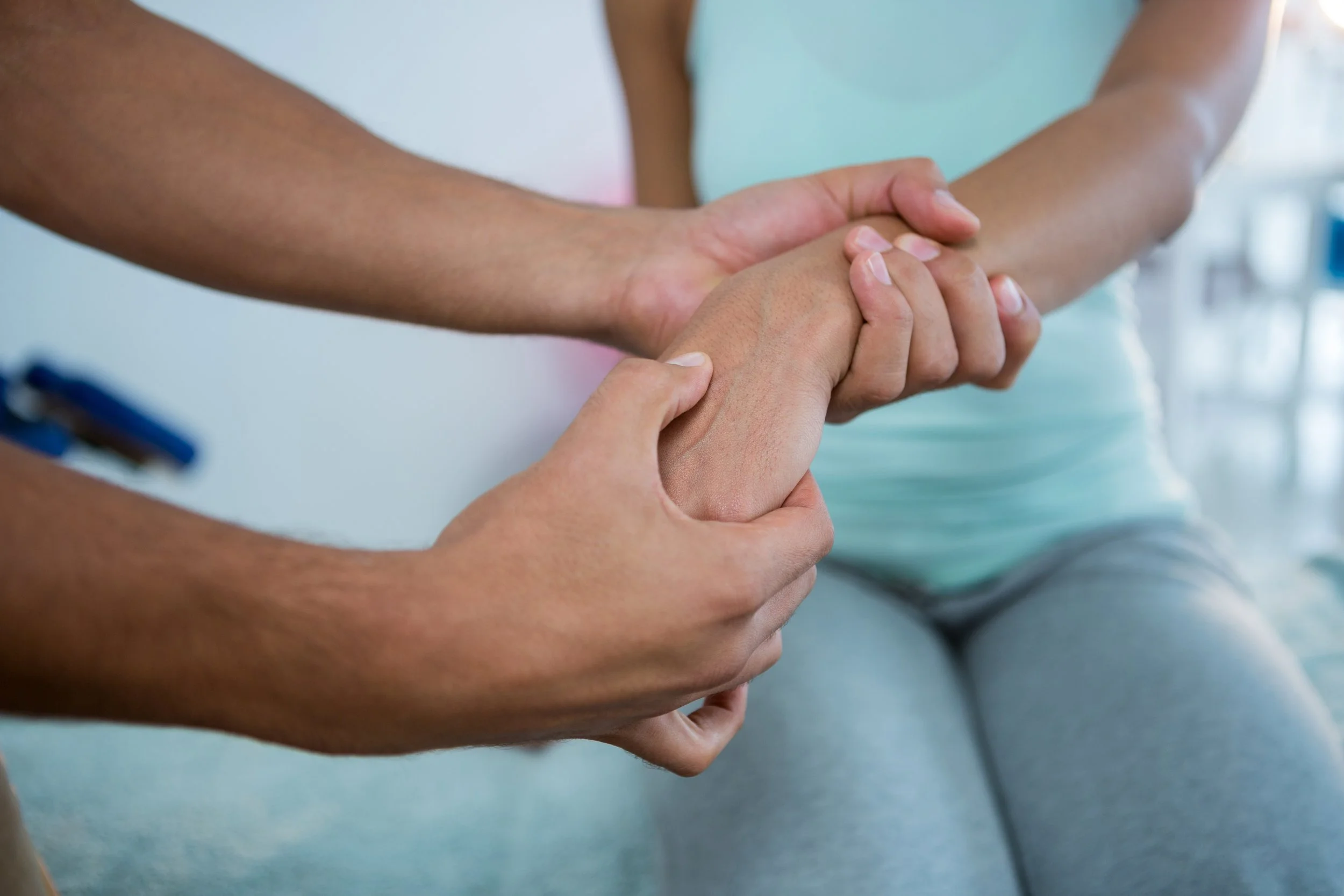


Carpal Tunnel Pain and How Acupuncture Helps

If you see someone wearing a wrist splint, it's likely due to carpal tunnel syndrome (CTS). Many attribute the rise of CTS to poor computer ergonomics or uncomfortable body positioning for long hours.

Symptoms include hand weakness, numbness and/or tingling of thumb and fingers except the little finger, and pain from the wrist area throughout the palm side of your forearm.

The carpal tunnel is a tube bound by bones and ligaments in the wrist area on the palm side of the hand. It is roughly the diameter of the thumb, and it houses and channels the median nerve, veins, and tendons for hand and finger mobility.

Whether by physical forces or injury compressing the carpal tunnel or by internal neurological inflammation or damage, CTS amounts to a pinched median nerve, blood vessel, or tendon damage in the carpal tunnel.

Although similar symptoms to CTS may arise from different types of work with arms and hands poorly positioned, if those symptoms dissipate quickly and easily it's probably not CTS, at least it's not serious.

Simply taking breaks, and shaking your arms and hands, then re-positioning your hands, arms, and general posture better should keep you from needing medical intervention.

But if the symptoms persist away from the job or after long hours of typing, you should seek medical attention.
 

Conventional modalities of medical attention

Conventional medicine offers adjustable splints that can be taken off and on at will. Many CTS sufferers wear them during work, but wearing the splint during sleep is also recommended.

Non-steroid anti-inflammatory drugs (NSAIDs) are usually recommended. Some have to be prescribed while others can be purchased over the counter (OTC). These only relieve pain with side effects. Sometimes cortisone injections are used to relieve the pressure from swelling on the median nerve.

If these don't help enough, surgery is used. Endoscopic surgery, involving a narrow tube inserted into small incisions, is the least invasive. It's sometimes used for injured knees. Open surgery, as the name implies, is the most invasive, requiring more anesthesia.
 

Acupuncture - A non-pharmaceutical, non-surgical CTS intervention

Acupuncture, which works on the energy (chi) distribution along the body's mapped out meridians, has been used for centuries for both optimizing good health and reversing bad health, acute or chronic.

Lately, acupuncture has been used successfully for healing maladies from sports injuries. A dramatic example occurred just before the Super Bowl in 1986 when Chicago Bears controversial quarterback Jim McMahon underwent acupuncture treatments for a severely bruised back that wasn't responding to conventional treatment.

After his acupuncture treatments, Jim said he felt 200 percent better, and he and the Bears blew out the Patriots in that Super Bowl. This news event raised eyebrows among classic medical skeptics, spiking acupuncture's burgeoning public acceptance in America.

A recent acupuncture for CTS study by an Iranian university's neurological department was published in January 2012's Journal of Research in Medical Sciences as "Acupuncture in treatment of carpal tunnel syndrome: A randomized controlled trial study."

64 sufferers of moderate CTS were divided into a control group receiving vitamins B1 and B6 with fake acupuncture. The other group received two acupuncture treatments weekly over a four week period and wore wrist splints nightly.

Guess which group tested better neurologically and had lower GSS (global symptom scores) reported for pain, weakness, tingling, and numbness. Yep, the acupuncture guys, of course.

The researchers concluded: "Our findings indicated that the acupuncture can improve the overall subjective symptoms of carpal tunnel syndrome and could be adopted in comprehensive care programs of these patients."

The complete study report is available in the sources below.

Sources for this article include:

http://www.mayoclinic.com/health/carpal-tunnel-syndrome/DS00326

http://www.apnewsarchive.com

http://www.vitasearch.com/get-clp-summary/40537

http://www.ncbi.nlm.nih.gov/pmc/articles/PMC3523426/


Learn more: http://www.naturalnews.com/038939_carpal_tunnel_acupuncture_treatment.html#ixzz40PI0IGZe

Prevent Back Pain While Driving

When you suffer from back pain, sitting in a car for hours can make it much worse. Even people who don’t normally endure lower back discomfort, can begin to experience it on a long car trip. However, by planning ahead and taking a few precautions, much of this back pain can be reduced or sometimes even prevented. Here are a few tips and ideas to help prevent back pain while driving or riding in a car.

Get Comfortable Immediately. When you first get into your car, make sure that you are sitting comfortably. Especially if you already have some back discomfort, sitting in an uncomfortable position will worsen the feeling.

Change Your Seat Position. Most of today’s cars have seats that place the driver’s pelvis lower than the driver’s knees. For most people, this makes a more comfortable chair. However, sitting in this position adds extra pressure on the tailbone. This pressure can be relieved by raising your seat so that your pelvis is parallel to your knees, or even slightly higher. If your seat is unable to move this way, you a wedge shaped cushion can help provide the same lower back pain relief.

Lumbar Support. If you have a long drive or lower back discomfort, you can take a small towel, roll it up and use it as a lumbar support. This can help relieve some pressure during a long trip.

Take Frequent Breaks and Stretch. You can go from rest stop to rest stop if you need to. At each stop, get out and stretch or exercise a bit. Walking helps to get your blood flowing again and will also help keep you awake. It is also very important to stretch your hamstrings. While sitting for extended periods of time, your hamstrings get shortened and tighter. Stretch them gently to relieve some tightness and help your lower back.

Trade off Driving When Possible. If you are driving with a partner, you can trade off driving so the other can relax and stretch. If you need to, go into the back seat and either lie down to rest, or you can stretch your legs out.

The most important thing to keep in mind, is to be aware that you have an issue and think through some things before you leave on a longer trip. It mostly comes down to common sense, but try to pack whatever back support items you may need and leave extra time so you can get out and walk around or stretch if needed.

Find another great resource for ways to prevent and relieve back pain while driving here.

This article originally appeared on relaxobak.com

Alignment is More than Just Good Posture

Remember when you were growing up and your mom (or your annoying aunt) would always correct you about your posture? “Stand up straight.” “Don’t slouch.” “Shoulders back.” Well, it was right… sort of. Body alignment is important. It affects many aspects of your health. But proper body alignment is more than just good posture.

Proper body alignment can help with body mechanics. That means it helps your body moves in a way that’s smart, efficient and with less risk of injury. In other words, body alignment will keep your body moving, sitting, standing, working, exercising, and being active for a long time. Proper alignment is very important, not only for your back, but for your overall health as well.

Proper body alignment helps the major systems in your body work better: digestive system, respiratory system, nervous system, immune system and more. In other words, everything runs better when the body is aligned.

Body alignment is important when exercising. Body alignment prevents injuries and balances how your muscle groups work. Also, when you are in alignment, you use less energy for any movement and put less stress on the joints. When movements are done from poor alignment position, there is greater wear and tear on joints and  greater is the risk of injury.

How to help body alignment.

Work on posture. Train yourself to recognize Neutral Spine Position—it’s when the pelvis, rib cage and skull are aligned on top of each other.  Instead of thinking of “standing up straight with your shoulders back” imagine being suspended from a string from the top of your head and all the other parts of the spine are suspended from the same string. When in neutral spine position, all 3 curves of the spine (cervical, thoracic and lumbar) are aligned and in natural balance. When you’re in this position, every movement activates from the core muscles.

You can find neutral spine position by practicing a basic relaxation exercise from the floor. You will eventually be able to recognize it while standing, sitting, reclining or moving.

Maintain a healthy weight. Excess weight puts additional stress on the joints and muscles.

Avoid certain body positions and movements. Having a slumped forward head posture, twisting from the spine to a point of strain, reaching for anything too far out from the body, bending from the waist to lift things or reach for things.

Exercise regularly with a program that promotes and builds core stabilization.

  • Squats, planks, push-ups, lunges can help strengthen your core. These should be done slowly and with attention to proper alignment. You may want to work with an exercise coach if you are not familiar with proper alignment and are new to an exercise program. Be sure to get approval from your doctor before starting any new exercise or stretching program.
  • Practice yoga which helps stretch the muscles, but also strengthens the core (and all major muscle groups). Most yoga classes are available for a wide range of fitness levels. Choose one that is appropriate for you.
  • Consider taking up Tai Chi, which emphasizes breathing and slow, balanced movements.
  • Try a class in Pilates, which also helps with body alignment and core strengthening. It was developed by Joseph Pilates, who overcame a sickly childhood and later did physical training with WWI soldiers who were recovering from injury.

Remember, all of these exercises can help with body alignment and strengthening your core. But not all exercises are good for everyone. People who have had spinal fusion or a slipped disk should be especially careful with any exercises and confer with their doctor.

This article originally appeared on relaxobak.com

Mapping Emotions in the Body Yields Consistent Global Results

Emotions manifest themselves as sensations in the body. While anxiety is often accompanied by a tight feeling in the chest, love may elicit a warm feeling throughout the body. But now, a new study from researchers in Finland reveals that perceptions of these sensations are consistently similar around the world, suggesting an underlying biological basis.

The researchers, from Aalto University, published the results of their study in the journal Proceedings of The National Academy of Sciences.

They note that emotions adjust not only our mental state, but also our bodily sensations.

In five experiments conducted online, the researchers showed over 700 participants - who were from Finland, Sweden and Taiwan - two silhouettes of bodies next to words, stories, movies or facial expressions that evoked emotions.

The participants were asked to color regions of the body where they felt activity was increasing or decreasing as they viewed each stimulus.

Results show that the most common emotions - including anger, fear, disgust, happiness, sadness, anxiety and love - produce strong sensations in the body, but the location for these sensations varies for different emotions.

For example, happiness triggered warm sensations throughout the whole body, whereas pride only activated the upper body, including the head and chest.

Interestingly, these sensations were consistently similar across the different cultures - West European and East Asian - which the researchers say suggests there is a biological basis for emotions and their corresponding sensations in the body.

Study participants consistently shaded the same body areas to indicate activation linked to certain emotions. Here, hot colors represent activated regions, whereas cool colors represent deactivated ones.
Image credit: Lauri Nummenmaa, Enrico Glerean, Riitta Hari and Jari Hietanen.

'Potential biomarker for emotional disorders'

Assistant Prof. Lauri Nummenmaa, from Aalto University, says that awareness of these corresponding changes in the body could bring about conscious emotional sensations, such as feeling happy.

In their conclusions, the researchers write:

"Monitoring the topography of emotion-triggered bodily sensations brings forth a unique tool for emotion research and could even provide a biomarker for emotional disorders."

They add that their findings have major implications for understanding the function of emotions in the body:

"We propose that emotions are represented in the somatosensory system as culturally universal categorical somatotopic maps. Perception of these emotion-triggered bodily changes may play a key role in generating consciously felt emotions."

Research for the study was funded by the European Research Council (ERC), the Academy of Finland and Aalto University.

Medical News Today recently reported on a study that suggested performance anxiety is better helped by telling yourself, "I'm excited," rather than "I am calm."

The researchers suggested this technique works because anxiety and excitement are emotional states that are both characterized by high arousal, and they are therefore more closely related.

This article originally appeared on medicalnewstoday.com and is written by Marie Ellis.