
Reflex Integration: What Is It and Why You Need to Know It

Primitive (infant) Reflexes are repetitive, automatic movements that are essential for development of head control, muscle tone, sensory integration and development. They form the basis of our postural, lifelong reflexes. These primitive reflexes surface in utero and infancy and become inhibited as the movements do their job and movements become more practiced and controlled. When a baby has been given the opportunity to develop freely and naturally the primitive reflexes will integrate and no longer be active. When the primitive reflexes remain active then many difficulties can emerge.

Incomplete integration of primitive reflexes may be a contributing cause of ADD/ ADHD, autism, learning challenges, developmental delay, sensory integration disorders, vision and hearing challenges, behaviour challenges, and extreme shyness, lack of confidence, addiction, inefficient, effortful striving, and constant feelings of overwhelm.

(The above article originally appeared here.)

The Missing Link

It has become apparent through the thousands of assessments completed by Dr. Masgutova that as the number of non-integrated primary infant reflexes increase in an individual, the range and severity of motor, communication, and cognitive challenges and emotional and behavioral regulation issues correspondingly increase. In 2004, Dr. Masgutova and her team tracked primary infant reflex assessment results for a population of 850 children, ages 1-12. The children and their conditions were classified according to the predominant diagnoses provided by their parents. From this work emerged the following general non-integrated reflex profiles for each characterized condition:
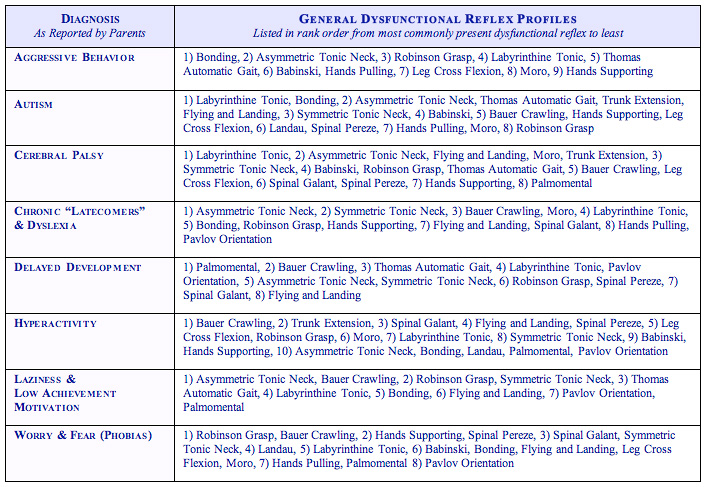
It is important to note that these are general, non-integrated reflexprofiles and are shared here to provide perspective regarding the primary infant motor reflexes that might not be integrated for individuals diagnosed with these conditions. Please remember that each individual is unique in their strengths and challenges and, therefore, should be assessed by a qualified MNRI trained resource to determine the actual integration status of primary reflex patterns for each individual.

Reflex integration can change lives. The verbally delayed child can begin to form intelligible sounds, words and/or simple sentences. Individuals with hypertonic rigidity can begin to relax clenched fists, rigid arms and/or legs. The disorganized may begin to move toward self-organization, the dysgraphic to write legibly, the sensory defensive to tolerate sounds, sights and/or touch opening up positive interaction with the world, shifting from an inner state of constant fear, distrust and concern to calm, wonder and joy. The prognosis and outcome for those accessing MNRI Method techniques will vary based on the:

  • Underlying cause of the condition -- Congenital disorders, trauma, chronic prolong or intermittent stress, or disease.
  • Which, how many, and to what extent the underlying neural, sensory and motor systems supporting reflex function are challenged.
  • Number and combination of primary infant reflexes are impacted as well as the developmental maturity of each impacted reflex.
  • Developmental time frame within which reflex integration work is completed -- before, during, or after the typical maturation and integration time period, and the
  • Rigor with which reflex integration work is completed.

Regardless of the magnitude, complexity, or apparent level of debilitation an individual faces, it is important to understand that dysfunctional or more deeply pathological primary infant motor reflexes, when addressed with the right combination of integration techniques, can lead to improved or even restored function. While the magnitude of the underlying neurosensorimotor challenges may limit the degree of restoration when addressed with the right combination of integration techniques, almost every individual may experience some level of functional improvement – moving them a step closer to reaching their unique potential. The first step to beginning this process is simply learning about the impact integrated primary infant reflexes can have on improved function. The next steps include identification of dysfunctional or pathological reflexes and figuring out the best way to begin the integration process. To learn more about beginning the integration process refer to our website section regarding treatment options. The earlier underlying neurosensorimotor challenges can be identified, the easier it will be to minimize or even eliminate the impact dysfunctional or pathological reflexes can have on overall maturation and development.

(The above article originally appeared here.)

Positive effects observed in a study out of Wroclaw Medical University in Poland via the Department of Pathophysiology.

The impact of rehabilitation carried out using the Masgutova Neurosensorimotor Reflex Integration method in children with cerebral palsy on the results of brain stem auditory potential examinations. 

Abstract

BACKGROUND:

Rehabilitation therapy in children with neuromotor development disorders can be carried out with the use of various methods.

OBJECTIVES:

The aim of this study was to determine the efficiency of rehabilitation carried out with the use of the new therapeutic method MNRI (Masgutova Neurosensorimotor Reflex Integration) in children with cerebral palsy (CP) by objective measurements with a brainstem auditory evoked potentials (BAEP) examination.

MATERIAL AND METHODS:

Besides the known parameters, Interpeak Latency I-V (IPL I-V) in BAEP, an original parameter proposed by Pilecki was introduced, called a relative IPL I-V value. The study involved a group of 17 children (9 girls and 8 boys) aged from 1.3 to 5.9 years (mean = 3.8 years, SD = 1.3) with cerebral palsy. Due to difficulty in co-operation, analysis of only 15 children could be finished.

RESULTS:

Analysis of the absolute IPL I-V values showed that after rehabilitation the percentage of the results with slowed transmission, i.e. those in which the IPL I-V value was prolonged, decreased from more than 88% to 60%. The assessment of the relative IPL I-V values showed that the results obtained after rehabilitation are more advantageous.

CONCLUSIONS:

As a result of rehabilitation carried out by the MNRI method in children with CP, a significant improvement in the transmission in the brain stem section of the auditory pathway was observed based on the absolute and relative IPL I-V values. However, the change obtained in children was various.

http://www.ncbi.nlm.nih.gov/pubmed/23214200

A New Way to Trick the Brain and Beat Jet Lag

For all its complexity, the human brain is not hard to deceive. Here are four studies where scientists have learned more about duping it.

The human brain is a remarkable, stunningly complex organ. And yet, scientists are discovering something about it that the likes of Harry Houdini and other great magicians have known for a long time—the brain can be surprisingly easy to trick.

That’s because in order to be so efficient, it has evolved to create shortcuts in response to outside stimuli, such as light or sound. But those shortcuts and the consistency with which the brain follows them can also make it vulnerable to deception.  

Take, for example, recent research by Stanford scientists exploring a new way to fight jet lag. For a while, researchers have known that exposure to light before taking a trip can help your body adjust to the changes in your sleep cycles that come with traveling across time zones. The most common preventive treatment involves sitting in front of bright lights for hours at a time during the day.

But the Stanford team, led by Jamie Zeitzer, an assistant professor of psychiatry and behavioral sciences, tried a different approach.  First, it looked at light exposure while someone was actually sleeping, and it found that the body’s circadian rhythms, which control sleep cycles, are more sensitive to light at night—even when a person’s eyes are closed.

Then, the researchers wondered if the kind of light passing through the eyelids makes a difference. They recruited 39 volunteers and had them get on a regular sleep cycle for two weeks—going to bed and waking up at the same times every day. Then they brought them into a sleep lab.

They divided the participants into two groups. Once they had fallen asleep, the people in one group were given the conventional treatment—exposure to continuous light for an hour. But the others were treated with a different kind of light—quick flashes 10 seconds apart, like a strobe.

What they found the next night is that the people exposed to the flashing light felt sleepy about two hours later than they had the first evening. For those given the continuous light treatment, sleepiness was delayed by only 36 minutes.

Biological hacking

Zeitzer, who refers to this therapy as “biological hacking,” says the light exposure works better at night because it fools the brain, as you fall asleep, into thinking the day is longer than it actually is. And that resets the body clock.

But why would a flashing light do this more effectively than a constant one?

According to Zeitzer, it has to do with the cells at the back of the eye, which send messages to the part of the brain that sets circadian rhythms. Those cells, he says, use the times of darkness between flashes to recover or recalibrate, and that apparently helps them be more responsive to the light when it reoccurs.

So far, he noted, most of those tested haven’t had a problem sleeping through the flashing lights. In the real world, Zeitzer sees the therapy working like this: Say, you’re flying across the U.S. from the West Coast to the East Coast. If you usually wake up at 8 a.m., you’d set a device to start the light flashes at 5 a.m. By the time you land, he says, your body clock should already be adjusting to East Coast time.

More tricks

Here are three other recent studies in which researchers have found how the brain can be deceived.

Don’t watch what you eat: If you can’t see what you’re eating, you’re less likely to eat as much. That’s the conclusion of scientists at the University of Konstanz in Germany after asking 90 students to eat three different flavors of ice cream.

Forty were told to evaluate the taste and texture of the ice cream, and then estimate how much they had eaten and whether they would buy that ice cream. Pretty straightforward. But the other 50 were thrown a bit of a curve. They were asked to do the same taste test blindfolded.

The results, published in the journal Food Quality and Preference, suggested that those who couldn’t see what they were eating estimated they had eaten almost twice as much as they actually did. They also ate less than the people without the blindfolds. Plus, they were less likely to say they would buy the ice cream.

Based on their findings, the researchers said that those who want to lose weight should try to eat with their eyes closed more often.

Beware of overthinking: A study at the University of Southern California found that if you want to develop a new habit, you should avoid thinking too much about it.

The researchers asked a group of people to watch a video that shows how to make sushi. And they determined that when people were able to watch the video over and over without any other specific instructions, they learned the sushi-making process better than those who were told to try to remember what came next.

The reason, according to researcher Jennifer Labrecque, is that habits are encoded in the brain by what’s known as the procedural memory system, which doesn’t involve much deliberative thinking. That’s what involved when you get back on a bike. But when you plan and concentrate on learning, you engage the declarative memory system, which remembers facts and personal experiences. 

When you try to use both systems at once, they can interfere with your learning, she said. You’re better off not thinking too hard when you’re trying to learn something new.

Is someone there?: Do you ever have that feeling where you can sense the presence of another person in the room with you when no one else is around? Well, scientists at the Swiss Federal Institute of Technology say it’s likely a case of your brain perceiving something that’s not there.

That’s based, in part, on research done with a group of people who were blindfolded, given ear plugs and had their fingers connected to a device. The subjects were told to move the device, and when they did, a robotic arm poked them in the back. Because the poke was synchronized with their movements, the subjects’ brains recognized it as something they had done to themselves.  

But when the researchers caused a slight delay between when the people moved the device and when they were poked, the study participants had a different reaction. They swore that not only was someone else touching them, but that they could actually feel another person’s presence. A few, in fact, found the experience so unsettling that they chose not to finish the experiment.

That strange sensation, according to the scientists, was caused by an altered perception within their brains, one that made them feel their own bodies had been replaced by someone else’s presence.


Read more: http://www.smithsonianmag.com/innovation/new-way-trick-brain-and-beat-jet-lag-180958271/#JbjX7sR1tC24DRdU.99
Give the gift of Smithsonian magazine for only $12! http://bit.ly/1cGUiGv
Follow us: @SmithsonianMag on Twitter

The Simple Key For Plantar Fasciitis Relief

Symptoms include heel pain, especially in the first steps after getting out of bed, and stiffness/pain in the mid foot.

Symptoms include heel pain, especially in the first steps after getting out of bed, and stiffness/pain in the mid foot.

There is a thick connective tissue that runs the entire length of the bottom of the human foot. It starts on the five toes and extends to the bottom of the heel. This tissue is known as the plantar fascia. While running,  runners land on the heels of the feet and then raise themselves on the toes before shifting the weight onto the other foot. This causes the plantar fascia to come under strain and when the strain becomes too much, the plantar fascia is likely to tear. Even if there is no tearing the strain can be felt and is an indication of plantar fasciitis. Mountain climbers, aerobics practitioners, and hikers can also become afflicted by plantar fasciitis due to constant strain on the plantar fascia during their exertions. Plantar fasciitis can also be caused by using the wrong footwear.

One of the best ways to start treatment of plantar fasciitis is to desist from the activity that is causing the pain, be it running, jogging, cycling, climbing or aerobics. Footwear should be such that it gives more support even though it may be stiffer. Arch supports can also help to reduce the pain and it is said that stretching of the calf muscles also affords some relief. Icing the area for about a quarter of an hour every day can also help. Massage of the calf and Achilles heel can also reduce pain. Once the initial recovery is made, patients should consider a more aggressive form of treatment. This could include taping and deep tissue massage. 

The Key: Deep Tissue Massage is a technique that concentrates on the deeper muscle tissues by applying deep pressure on the fascia, Achilles heel, and calf muscles through slow strokes, relieving tension in tight tissues. The muscle fibers can be followed or pressure can be applied across tendons. Deep tissue massage can help to release the muscle tension, break scar tissue, and lead to its elimination. It concentrates on specific areas, leading to soreness before and after the massage, yet the results are definite and can be felt within just a couple of days. 

Deep tissue massage loosens the muscle tissues, remove muscle toxins, and ensure proper circulation of blood and oxygen which had been affected by plantar fasciitis. Following the treatment, it is advisable to drink a lot of water to help remove the toxins from the body. Deep tissue massage is not recommended, however, if there are any open wounds on the plantar fascia or in nearby areas. It has to be avoided if surgery has taken place and if other conditions like osteoporosis exist. Persons who have a history of blood clots should also not undergo deep massage therapy as these blood clots can be displaced and get to areas where they cause greater problems.

Deep tissue massage works because it physically breaks down the adhesions that are formed by muscle tissues in the muscles caused by over exertion or strain. 

- See more at: http://www.pacificcollege.edu/news/blog/2014/12/05/deep-tissue-massage-plantar-fasciitis#sthash.n960Hk3N.dpuf


Acupuncture - The Oldest Health Care System in the World

The origins of acupuncture in China can be traced back at least 2000 years, making it one of the oldest and most long-standing health care systems in the world. Today, acupuncture is an effective, natural and increasingly popular form of health care that is being used by people from a wide range of cultural and social backgrounds.

Acupuncture is a time-honoured medicine and takes a holistic approach to understanding normal function and disease processes and focuses as much on the prevention of illness as on the treatment.

What is qi & how does it affect the body?
When healthy, an abundant supply of qi (pronounced chee) or "life energy" flows through the body's meridians (a network of invisible channels through the body). If the flow of qi in the meridians becomes blocked or there is an inadequate supply of qi, then the body fails to maintain harmony, balance and order, and disease or illness follows. This can result from stress, overwork, poor diet, disease pathogens, weather and environmental conditions, and other lifestyle factors and becomes evident to TCM practitioners through observable signs of bodily dysfunction. TCM practitioners look carefully for these signs of health and dysfunction, paying particular attention not only to the presenting signs and symptoms, but also to the medical history, general constitution, and the pulse and tongue.

How does acupuncture work?
Acupuncture treatment involves the insertion of fine, sterile needles into specific sites (acupuncture points) along the body's meridians to clear energy blockages and encourage the normal flow of qi through the individual. The practitioner may also stimulate the acupuncture points using other methods, including moxibustion, cupping, laser therapy, electro-stimulation and massage, in order to re-establish the flow of qi.

As a natural form of healing, acupuncture has the following benefits:

  • provides drug-free pain relief
  • effectively treats a wide range of acute and chronic ailments
  • treats the underlying cause of disease and illness as well as the symptoms
  • provides an holistic approach to the treatment of disease and illness, linking body, mind and emotions
  • assists in the prevention against disease and illness as well as the maintenance of general well-being

Acupuncture is known to treat a wide range of disorders including:

  • Neurological conditions such as headaches, migraines, difficulty sleeping, nervous tension, stroke, some forms of deafness, facial and inter-costal neuralgia, trigeminal neuralgia, some forms of paralysis, sequelae of poliomyelitis, peripheral neuropathy, noises in the ears, dizziness, and Meniere's disease.
     
  • Cardiovascular disorders such as high or low blood pressure, fluid retention, chest pain, angina pectoris, poor circulation, cold hands and feet, and muscle cramps.
     
  • Respiratory conditions such as bronchial asthma, acute and chronic bronchitis, acute tonsillitis, rhinitis, sinusitis, hay fever, chronic cough, laryngitis, sore throat, influenza and the common cold.
     
  • Digestive system disorders such as toothache, post-extraction pain, gingivitis, mouth ulcers, hiccough, spasms of the oesophagus, gastric and duodenal ulcers, gastric hyperacidity, gastritis, heartburn, hiatus hernia syndrome, flatulence, paralytic ileus, colitis, diarrhoea, constipation, haemorrhoids, liver and gall bladder disorders, and weight control.
     
  • Urogenital disorders such as cystitis, prostatitis, orchitis, low sexual vitality, urinary retention, kidney disorders, nocturnal enuresis, and neurogenic bladder dysfunction.
     
  • Gynaecological and obstetric disorders such as premenstrual tension, painful, heavy or irregular, or the absence of periods, abnormal uterine bleeding or discharge, hormonal disturbances, disorders associated with menopause, prolapse of the uterus or bladder, difficulty with conception, and morning sickness.mu
     
  • Skin conditions such as eczema, dermatitis, psoriasis, nerve rash, herpes zoster, acne, scar tissue and resultant adhesions, hair loss and dandruff.
     
  • Eye conditions such as visual disorders, red, sore, itchy or watery eyes, conjunctivitis, simple cataracts, myopia in children, and central retinitis.
     
  • Musculoskeletal disorders such as osteoarthritis, sciatica, lumbago, weak back, low back pain, rheumatoid arthritis, gout, tenosynovitis, shoulder and neck pain, cervicobrachial syndrome, 'frozen shoulder', and 'tennis elbow'.
     
  • Sporting injuries such as sprained ankles and knees, cartilage problems, corking and tearing of muscles, torn ligaments and bruises.
     
  • Psychological conditions such as depression, phobias, emotional disturbances, anxiety, nervousness and addictions such as smoking.

* The disorders above which appear in bold have been recognised by the World Health Organisation (December 1979) as having been successfully treated by acupuncture. The disorders which do not appear in bold above are other common disorders which have been found to respond well to acupuncture.

This article originally appeared on
http://www.acupuncture.org.au