

Sleeping Around: How to Sleep in a Sensory Deprivation Tank

“Sleeping Around” is a recurring blog post series where Dr. Winter, a sleep specialist, goes beyond the typical questions about healthy sleep and seeks out the most unique sleep circumstances to offer his assistance in how to tackle them. Even if your problems are not as extreme, hopefully the experience can help shed some light on your own sleep difficulties.

In 1953, neuroscientist John Lilly constructed the first sensory deprivation tank. This vessel was devised as a way to study the brain’s response to limited sensory input. The tank immersed the user into a totally dark and silent environment in which sound and vision as well as other sensory inputs were virtually eliminated. The theory at the time was if all sensory inputs were cut off to the brain, the brain would reflexively go to sleep. Lilly, a self-described “psychonaut”, used the tank to study these and other kinds of theories. Today, the study of sensory deprivation, or Restricted Environmental Stimulation Technique (R.E.S.T.), has led to a more widespread use of these techniques to promote health and well-being.

Being the somnonaut that I am, I have always been interested in trying to sleep in a R.E.S.T tank. While I was never convinced that I would emerge from the experience transformed into a short, hairy primitive being as in the 1980 William Hurt movie Altered States, I have always believed that the experience could be transformative.

Float tanks have been around. As someone who deals with professional sports teams, they have been used sporadically by both college and professional teams since the early 1980’s. Recently, members of both the New England Patriots and Seattle Seahawks utilized float tanks with their athletes. Their use has seen resurgence in popularity owning to their proclaimed abilities to promote relaxation, physical recovery, and pain relief.

Sign me up.

Every somnonaut needs a mission control, and AquaFloat in Charlottesville, VA filled that role perfectly. Owner and float expert Ted O’Neill met me at the facility the night of my experiment. I chose the 10 p.m. slot as I thought my chances of sleeping would be best. Slots were two hours long, but Ted does not like to interrupt a good float if nobody is signed up behind the floater.

Ted was clearly excited to be a part of yet another maiden voyage. He was enthusiastic, but calm and professional. As a pharmacist who stumbled upon floating by chance, Ted’s life was forever changed by the encounter. Put it this way: If Ted owned a corn farm, he would have plowed it up to build a baseball field. The facility was gorgeous. I expected a Spartan warehouse with industrial tanks scattered about. The aesthetics featured gentle sweeping architectural curves and local artists’ sculptural interpretations of floating. I can definitely sleep here.

After surveying the lounge, he led me to the various tanks, explaining their strengths and drawbacks. He was also careful to demonstrate the filtration systems servicing the tanks (as if something could live in an environment that is 25 percent Epsom salt!) That salt produces the magical buoyancy not unlike what you might see when tourists swim in the Great Salt Lake. “You are not going to sink,” Ted said. “When you get into the tank, I want you to fully relax your head and neck. Release those muscles completely.”

Time to get into the tank.

The tank had quiet lighting that was slowly changing color. “The light can be left on or turned off. “ He strongly recommended dark. Likewise, the hood of the tank can be left open or closed. He suggested leaving the hood open slightly if I started to feel to warm during the float. The room was dark enough that cracking the hood open a bit would not make a difference in terms of light.

“Do I wear a swimsuit?” I asked, shorts in hand.

He shook his head. “Naked. It’s the only way.”

It was time.

After a quick shower, I ventured into the tank. The temperature was perfect. Not hot, not cool. Perfectly comfortable. It was so on point that the water almost disappeared.

As I lay back, I floated effortlessly. I stretched my head backwards to the point of my eyes almost being in the water, and then let gravity slowly relax me to a neutral position. This is so easy. I loved it immediately.

With the hood down, it was time to cut the light. Immediately I was swallowed by a dense darkness. Floating there, I became aware of my first obstacle. What in the world am I supposed to do with my arms? Initially I had them down by my sides, but found that they kept floating around like pieces of driftwood. As my thumbs bumped into my legs, the floating experience was diminished. I quickly assumed the “robbery-hands-over-my-head” position and found it to be much more pleasant.

Within minutes of my positional decision and a quick mental toe to scalp muscle survey, I was floating...REALLY floating, and to borrow a phrase from Bowie, “in a most peculiar way.” Unusual experiences quickly followed. My first was an intense sensation of being pulled upward. Imagine a cord being attached to your abdomen at a point where you would be perfectly horizontally balanced. Now imagine that cord being rapidly pulled upward. The experience reminded me of the unknowing sleeper being pulled up into the UFO from the comfort of his bed. Maybe that sensation underlies the feeling people have recounting UFO abductions? What accounts for the subsequent sensation of being probed, I have no idea.

As the feeling of upward motion continued, I started to feel as if I was moving within an infinite space. An individual preparing to float for the first time might be anxious about claustrophobia. My sensation was exactly the opposite. I felt a sensation of endless space around me, like the drifting disconnected astronaut in 2001 as he floats silently away from the spaceship and HAL.

As I worked to adjust to sensations I frankly was not prepared for, I began to focus on my task at hand: sleeping. Sleeping is not typically the goal during the actual float. That said, many people who regularly float report significant sleep improvements after the float. I worked to clear my mind, although I was instructed to simply let my thoughts flow and perhaps try watching them from afar. As I became more accustomed to the physical nothingness I was within, the state began to seep into my brain. I was relaxed and at times felt nothing.

Suddenly soft colored lights came on. My first emotion was annoyance. Can somebody here not figure out how to set a two hour timer? As I reached for a towel hanging to my right so I could wipe some water off of my face, I became aware of how laborious it was to perform a simple movement. It felt awful. My body did not want to engage the muscles of my arm and back and was pointedly letting me know. Pushing through the resistance, I reached for the non-existent towel. In the soft purple light, I searched for it (without my glasses) and found nothing. Had it fallen in the water? In my search I found the towel hanging to my left. I grabbed it, and tried to push the lid of the pod open to exit the tank so I could find Ted and tell him to fix the timer. At that point I realized I was sitting backwards in the tank. The hatch was behind me.

I had turned 180 degrees in the tank.

I gracelessly turned my body around which had the coordination of a wobbly toddler, opened the hatch and stepped out. “I hate being upright,” my brain whispered to me in a bitchy voice as I looked for my watch.

12:15am. What?

As I showered and dressed, thoughts were racing as my body once again reassumed the burden of gravity similar to Atlas being tricked into bearing the weight of the world again by Hercules. Walking out into the lounge for tea, Ted was ready to listen and explain. Everything I mentioned he accepted with a knowing curiosity. He’s heard these stories before.

Did I sleep? Under no circumstances do I feel like I slept in the tank. However, it was very clear that I lost tremendous chunks of time in the tank. It did not feel like two hours. As a sleep specialist, one phenomenon that never ceases to amaze me is how much individuals with sleep problems can radically underestimate how much they are sleeping at night. People who sleep hours at night can truly feel that they are awake and conscious for the entire duration of their slumber period. It is not a fun way to spend a night. This twilight sleep (now called paradoxical insomnia) is a common issue among my patients.

“Promise me you’ll come back. You’ve just scratched the surface. It gets much better.” I felt the effects of the session for days. Even my wife said I looked different when I came home that night. I felt like a cooked noodle. While I have not returned as of writing this article, I think it’s only a matter of time before the weight of my clinical practice, raising three kids, flying around the country trying to help athletes sleep better lead me to dash out the door for a float. I can almost hear my wife calling after me, “Don’t you need a swimsuit?”

“Nope. Naked is the only way!”

This article originally appeared on Huffington Post and was written by Dr. Christopher Winter
The efficiency of the body: Fascia and your health

Tensegrity and the body

Tensegrity is an elision of ‘tension + integrity’. Buckminster Fuller, building on the highly original sculptures of Kenneth Snelson, coined the term, to indicate that the integrity of the structure derived from the balance of tension members, not the compression struts. Can you see? (The easiest way to understand tensegrity is to have a model in your hand – then these properties are self-evident.) Cut the strings and it would collapse totally.

Most of our houses and other man-made structures are ‘compressionegrities’ – their integrity lies with the continuity of compression from the highest brick in the Empire State Building to the lowest block of granite – the compression runs in an unbroken line from element to element all the way to the ground.


Tom and Dr. Steven Levin, developer of biotensegrity

We have thought of our bodies in the same way: the skeleton is a stack of bones, like a stack of checkers – a continuous compression structure – with the individual muscles hanging off each bone to move it.


But every classroom skeleton you have ever seen is wired together. Similarly, in the actual skeleton the bones float in a sea of soft-tissue.


Fascial continuity suggests that the myofascia acts like an adjustable tensegrity around the skeleton – a continuous inward pulling tensional network like the elastics, with the bones acting like the struts in the tensegrity model, pushing out against the restricting ‘rubber bands’.

Tensegrity’s unique features

Playing with these models reveals several unique features: Put strain into a tensegrity structure and the deformation will get distributed all over the structure. Continuous compression structures like buildings do not show this property, but bodies do. Load one corner of a building with a huge amount of snow, and that corner might collapse, leaving the rest of building intact. Load a tensegrity, and it will distribute the strain around the whole structure. Ergo: Where will a strained compression structure break? where the strain is greatest. Where will a tensegrity structure break under strain? at its weakest point.  If we are a tensegrity structure, the ‘load’ that is causing pain or strain in the low back may be sourced in the foot or the shoulder – so we have to be able to see the pattern to know where to intervene.  Erik Dalton says “Don’t chase the Pain!”.  Ida Rolf said :Where you think it is, it ain’t.”  Both of these point to the tesnegrity nature of the body.

Expansion
Often our clients’ bodies are contracted and retracted and immobilized in some ways, in some parts. We want to engender an opening, expansion, a filling of space until the person is fully expressed, not constrained. Tensegrities expand in all axes at once: open the structure in one dimension and every dimension expands. Neither buildings nor balloons display this property, but tensegrity structures and bodies do.

Research into fascia has shown how it works on many levels as a distributive network. The body is at least responding like a tensegrity structure, and many of us believe that it is operating as a tensegrity structure. Perhaps it operates more like a tensegrity structure in Fred Astaire than it does in Jackie Gleason.

Efficiency
Tensegrities can be built in hierarchies – each element of a tensegrity can be built out of smaller tensegrities – making for the most efficient use of materials, an evolutionary imperative. This efficiency is also a very important property, as the rule of biological evolution is efficiency – getting the most performance from the least material.

Research into fascia has shown how it works on many levels as a distributive network. The body is at least responding like a tensegrity structure, and many of us believe that it is operating as a tensegrity structure. Perhaps it operates more like a tensegrity structure in Fred Astaire than it does in Jackie Gleason.

This article originally appeared on www.anatomytrains.com

Yoga Therapy: The Newest Health Trend that Doctors are Paying Attention To

Wellness enthusiasts have long known the healing benefits of yoga. However, the popularity of this ancient practice is now growing among today’s mainstream, especially doctors. Today, there is a rise in doctor-prescribed yoga therapy, even among Western-trained doctors.

So what is yoga therapy? Why is it a growing trend? Will yoga therapy help patients feel better? Here is some insight.

What is Yoga Therapy?

Yoga therapy involves a variety of practices that can help ease a natural process or improve a health condition. Some of the therapeutic tools that are used are breathing exercises, physical postures, guided imagery and meditation. Diet is also considered part of yoga therapy.

While regular yoga, depending on the type, can be fast-paced and physically demanding, yoga therapy serves as a safe, gentler alternative. It is led by yoga teachers who are specially trained to work with patients suffering from various health conditions. Just as each patient is different, the styles and formats of yoga therapy also differ greatly. They can vary from small therapeutic classes and one-on-one sessions to chair yoga in nursing homes and hospitals.

Yoga therapy takes a more holistic approach to healing, focusing on patients as a whole instead of just on their conditions. The practice simultaneously works on the body, mind, and spirit, strengthening the body’s different systems. These include the heart and cardiovascular system, muscles, the lungs, as well as the body’s nervous system.

Individuals may suffer from multiple conditions at once, so yoga therapy can be a multi-purpose form of healing. Yoga practices can simultaneously improve digestive system function, nurture psychological well-being, and enhance delivery of oxygen to the body’s tissues. Yoga also can assist the body to more effectively remove carcinogens, waste products and toxins.

Why Is It a Growing Trend?

Yoga therapy is still considered to be a new professional field. However, it is now recognized worldwide as a clinically viable treatment. There are established yoga therapy programs at major health care centers and clinics around the United States. It is increasingly being used regularly in health care facilities and hospitals. As more and more physicians see that yoga therapy helps their patients feel better, it is increasingly becoming a component of medical care.

For the last 12 years, the International Association of Yoga Therapists (IAYT), which has over 3,400 individual members from 48 countries, has worked hard to establish yoga as an esteemed and recognized therapy in the West. It has published an annual peer-reviewed medical journal, presented at academic research conferences, and received an NIH grant to create rigorous yoga therapy certification standards. It is now accrediting training programs and beginning to certify therapist graduates.

The IAYT database of yoga-therapy training programs has grown from five in 2003 to more than 130 schools worldwide today. These include 24 arduous multi-year programs that have been recently accredited by IAYT; there are an additional 20 still under review. As of 2015, most IAYT yoga-therapy practitioners work in hospital settings, while others work in outpatient clinics or physical therapy, oncology, or rehabilitation departments as well as in private practice.

Clinical research is partly responsible for the growing acceptance of yoga therapy in the health care sector. A growing body of research documents the proven benefits of yoga when using it to treat a wide range of health conditions, including anxiety, back pain, insomnia and depression. It is also proven to help reduce risk factors for hypertension and cardiovascular disease. Research also shows that yoga therapy has been successful in alleviating the side effects of cancer treatment. Some patients who have practiced yoga while undergoing radiation therapy have reported lower levels of fatigue, stress and a better quality of life.

Is Yoga Therapy Effective?

Yoga therapy has been proven to be a particularly effective way to reduce stress. This is good news for most people in the West, who encounter high levels of stress on a daily basis. Stress has been known to cause or contribute to varying medical problems, ranging from irritable bowel syndrome, migraine headaches and potentially life-threatening conditions such as heart disease, diabetes and osteoporosis.

When combined with other types of health care, whether alternative or conventional, yoga therapy has proven to be particularly effective, especially in healing chronic ailments. For instance, studies show that in addition to reducing the side effects of chemotherapy and radiation treatments for cancer patients, yoga therapy can also enable faster recovery after bypass surgery. In clinical trials, many patients with high blood pressure, type II diabetes or asthma, who began practicing yoga regularly, were able to lower the lower the dosage of drugs they needed or eliminate some pills entirely. For patients, less medication means fewer side effects, not to mention, greater monetary savings.
The Future of Yoga Therapy

It will still take more time for the practitioners and patients to fully accept yoga therapy as a primary approach to their medical treatment. But even as a supplemental approach, yoga therapy is making great strides. The growing body of scientific research documenting its health benefits is great evidence that yoga therapy is here to stay.

This article originally appeared on huffingtonpost.com and was written by Avital Scharf.

Yoga Therapy services available through Reset Wellness, visit our website for more details.

The health benefits of Tai Chi

This gentle form of exercise can help maintain strength, flexibility, and balance, and could be the perfect activity for the rest of your life.

Tai chi is often described as "meditation in motion," but it might well be called "medication in motion." There is growing evidence that this mind-body practice, which originated in China as a martial art, has value in treating or preventing many health problems. And you can get started even if you aren't in top shape or the best of health.

In this low-impact, slow-motion exercise, you go without pausing through a series of motions named for animal actions — for example, "white crane spreads its wings" — or martial arts moves, such as "box both ears." As you move, you breathe deeply and naturally, focusing your attention — as in some kinds of meditation — on your bodily sensations. Tai chi differs from other types of exercise in several respects. The movements are usually circular and never forced, the muscles are relaxed rather than tensed, the joints are not fully extended or bent, and connective tissues are not stretched. Tai chi can be easily adapted for anyone, from the most fit to people confined to wheelchairs or recovering from surgery.

Tai chi movement

A tai chi class practices a short form at the Tree of Life Tai Chi Center in Watertown, Mass.

"A growing body of carefully conducted research is building a compelling case for tai chi as an adjunct to standard medical treatment for the prevention and rehabilitation of many conditions commonly associated with age," says Peter M. Wayne, assistant professor of medicine at Harvard Medical School and director of the Tai Chi and Mind-Body Research Program at Harvard Medical School's Osher Research Center. An adjunct therapy is one that's used together with primary medical treatments, either to address a disease itself or its primary symptoms, or, more generally, to improve a patient's functioning and quality of life.

Belief systems

You don't need to subscribe to or learn much about tai chi's roots in Chinese philosophy to enjoy its health benefits, but these concepts can help make sense of its approach:

  • Qi — an energy force thought to flow through the body; tai chi is said to unblock and encourage the proper flow of qi.

  • Yin and yang — opposing elements thought to make up the universe that need to be kept in harmony. Tai chi is said to promote this balance.

Tai chi in motion

A tai chi class might include these parts:

Warm-up. Easy motions, such as shoulder circles, turning the head from side to side, or rocking back and forth, help you to loosen your muscles and joints and focus on your breath and body.

Instruction and practice of tai chi forms. Short forms — forms are sets of movements — may include a dozen or fewer movements; long forms may include hundreds. Different styles require smaller or larger movements. A short form with smaller, slower movements is usually recommended at the beginning, especially if you're older or not in good condition.

Qigong (or chi kung). Translated as "breath work" or "energy work," this consists of a few minutes of gentle breathing sometimes combined with movement. The idea is to help relax the mind and mobilize the body's energy. Qigong may be practiced standing, sitting, or lying down.

Getting started

The benefits of tai chi are generally greatest if you begin before you develop a chronic illness or functional limitations. Tai chi is very safe, and no fancy equipment is needed, so it's easy to get started. Here's some advice for doing so:

Don't be intimidated by the language. Names like Yang, Wu, and Cheng are given to various branches of tai chi, in honor of people who devised the sets of movements called forms. Certain programs emphasize the martial arts aspect of tai chi rather than its potential for healing and stress reduction. In some forms, you learn long sequences of movements, while others involve shorter series and more focus on breathing and meditation. The name is less important than finding an approach that matches your interests and needs.

Check with your doctor . If you have a limiting musculoskeletal problem or medical condition — or if you take medications that can make you dizzy or lightheaded — check with your doctor before starting tai chi. Given its excellent safety record, chances are that you'll be encouraged to try it.

Consider observing and taking a class. Taking a class may be the best way to learn tai chi. Seeing a teacher in action, getting feedback, and experiencing the camaraderie of a group are all pluses. Most teachers will let you observe the class first to see if you feel comfortable with the approach and atmosphere. Instruction can be individualized. Ask about classes at your local Y, senior center, or community education center. The Arthritis Foundation (www.arthritis.org; 800-283-7800, toll-free) can tell you whether its tai chi program, a 12-movement, easy-to-learn sequence, is offered in your area.

If you'd rather learn at home, you can buy or rent videos geared to your interests and fitness needs (see "Selected resources"). Although there are some excellent tai chi books, it can be difficult to appreciate the flow of movements from still photos or illustrations.

Talk to the instructor. There's no standard training or licensing for tai chi instructors, so you'll need to rely on recommendations from friends or clinicians and, of course, your own judgment. Look for an experienced teacher who will accommodate individual health concerns or levels of coordination and fitness.

Dress comfortably. Choose loose-fitting clothes that don't restrict your range of motion. You can practice barefoot or in lightweight, comfortable, and flexible shoes. Tai chi shoes are available, but ones you find in your closet will probably work fine. You'll need shoes that won't slip and can provide enough support to help you balance, but have soles thin enough to allow you to feel the ground. Running shoes, designed to propel you forward, are usually unsuitable.

Gauge your progress. Most beginning programs and tai chi interventions tested in medical research last at least 12 weeks, with instruction once or twice a week and practice at home. By the end of that time, you should know whether you enjoy tai chi, and you may already notice positive physical and psychological changes.

No pain, big gains

Although tai chi is slow and gentle and doesn't leave you breathless, it addresses the key components of fitness — muscle strength, flexibility, balance, and, to a lesser degree, aerobic conditioning. Here's some of the evidence:

Muscle strength. Tai chi can improve both lower-body strength and upper-body strength. When practiced regularly, tai chi can be comparable to resistance training and brisk walking.

"Although you aren't working with weights or resistance bands, the unsupported arm exercise involved in tai chi strengthens your upper body," says internist Dr. Gloria Yeh, an assistant professor at Harvard Medical School. "Tai chi strengthens both the lower and upper extremities and also the core muscles of the back and abdomen."

Flexibility. Tai chi can boost upper- and lower-body flexibility as well as strength.

Balance. Tai chi improves balance and, according to some studies, reduces falls. Proprioception — the ability to sense the position of one's body in space — declines with age. Tai chi helps train this sense, which is a function of sensory neurons in the inner ear and stretch receptors in the muscles and ligaments. Tai chi also improves muscle strength and flexibility, which makes it easier to recover from a stumble. Fear of falling can make you more likely to fall; some studies have found that tai chi training helps reduce that fear.

Aerobic conditioning. Depending on the speed and size of the movements, tai chi can provide some aerobic benefits. If your clinician advises a more intense cardio workout with a higher heart rate than tai chi can offer, you may need something more aerobic as well.

This article originally appeared on www.health.harvard.edu.

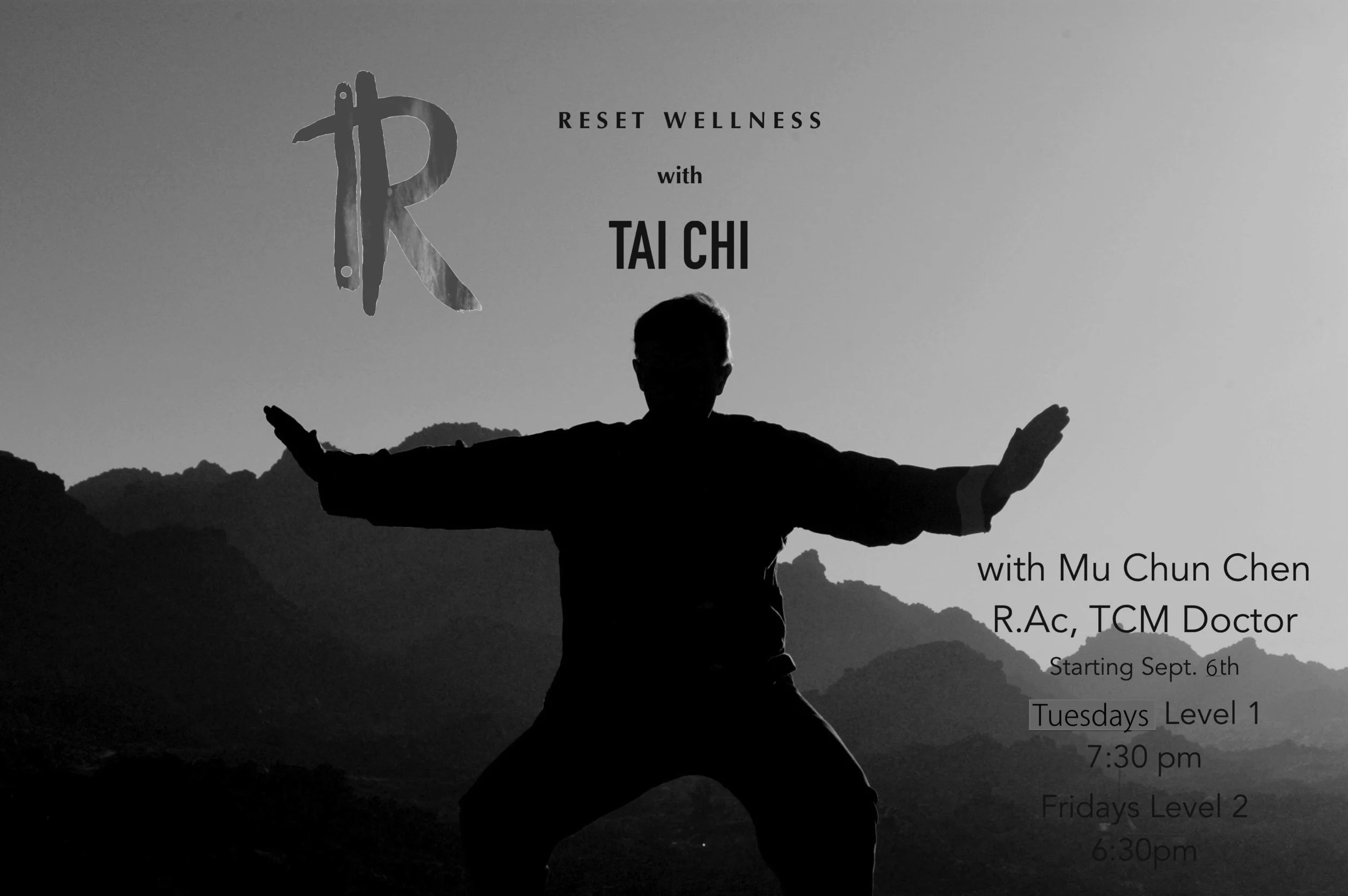
Tai Chi class series at Reset Wellness, Level 1 & 2  register online